The Profitless Boom
I’ll start this [week’s] story with a number. Twenty-eight billion dollars. That's roughly what Japan's anime industry earned in 2025, according to preliminary figures from the Association of Japanese Animations, presented recently at TIFFCOM, the content market that runs alongside the Tokyo International Film Festival. In yen, it's somewhere around four and a half trillion, a record, and up nearly sixteen percent from the year before. It's the first time the industry has cleared four trillion yen.
Now for another number. About fifty-seven percent of that money came from outside Japan. For the third year in a row, overseas sales beat domestic ones, and the gap keeps widening. Anime is no longer a Japanese industry with some foreign fans. It's a global industry that happens to be drawn mostly in Japan.
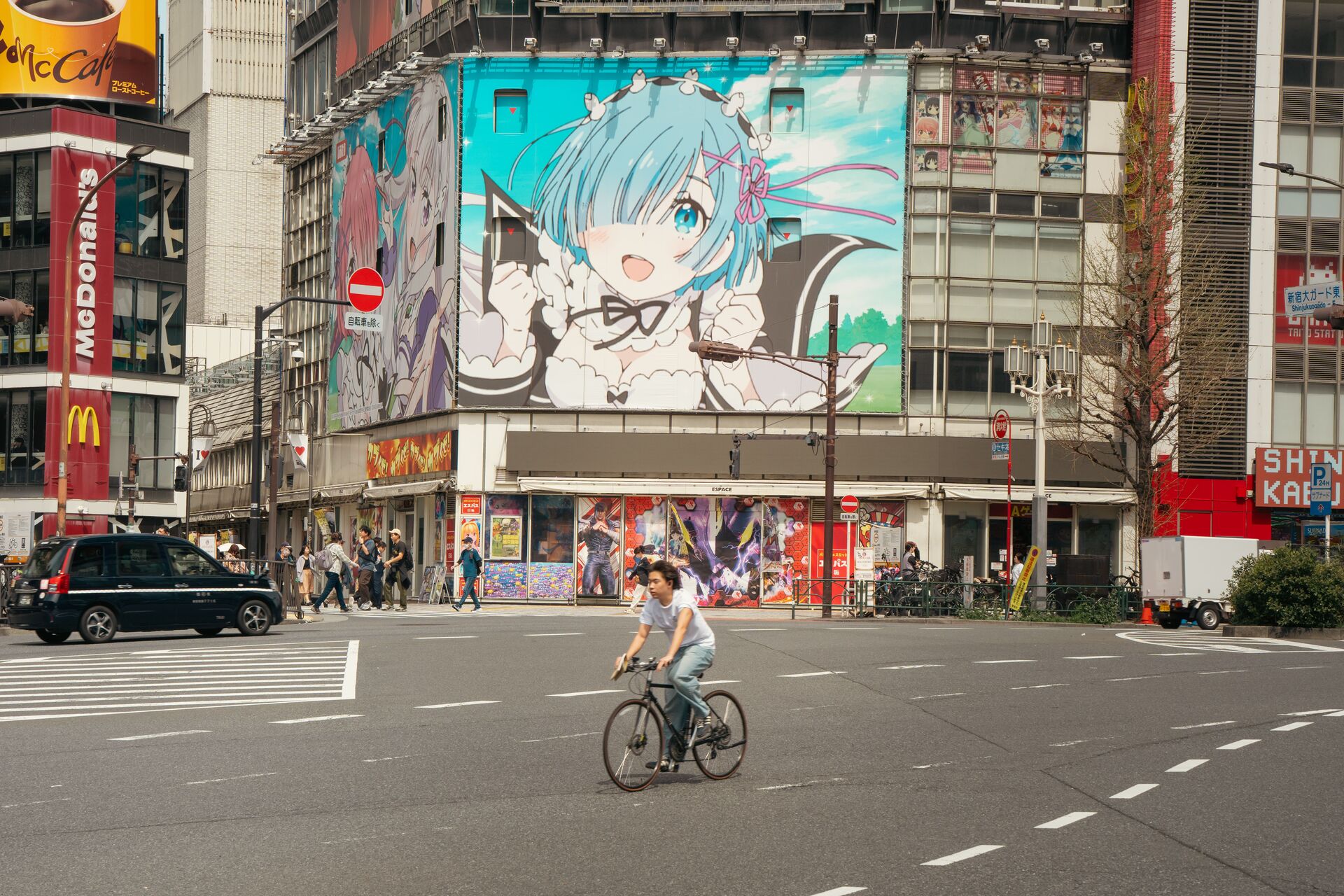
And the domestic side is hardly sleepy. Japan's box office hit a record of roughly two hundred seventy-five billion yen in 2025, up about a third, and a single film, Demon Slayer: Infinity Castle, took in around thirty-nine billion yen at home. Living in Tokyo, it's hard to miss how thoroughly anime has soaked into daily life, from train station posters to convenience store tie-ins. The government has noticed too. Its target is twenty trillion yen a year in overseas content sales by 2033, with anime expected to deliver something like six trillion of that.
So that's the good news. Now for the...less good.
The Profitless Boom
There's a phrase that circulates among people who follow the business side of anime: the profitless boom. Revenue goes up. Hit shows break records. And yet the studios that actually make the animation, and the people who draw it, mostly don't seem to be sharing in the windfall.
I should be careful here, because some of the most striking statistics come from secondary sources, and so I want to treat them as indicators rather than gospel. One 2024 analysis found that over a third of anime production companies reported losses, in the same year the industry set a record. Another breakdown suggests that studios see only a small single-digit percentage of overseas revenue, something like six percent, and a modest slice of domestic revenue as well. And a study by the Japan Research Institute is often cited for a retention problem: roughly a quarter of animators leaving within four years, more than two-thirds within eight.
You don't have to rely on the secondary numbers to see the pattern, though. In December 2025, Japan's Fair Trade Commission published a report on the anime and film production sector that found widespread dissatisfaction over pay and contracts that many creators described as opaque. When a competition regulator starts looking into an industry's payment practices, that's a sign the grumbling has moved from the break room to the government regulator’s desk.
A System Built to Be Cheap
So how did a business this successful end up this fragile? The short answer is that it was built that way. After Mushi Production, the studio founded by Osamu Tezuka, went bankrupt in 1973, the industry moved toward contract work and piece-rate pay. Production got broken into small steps, handed off to small studios, and eventually to firms overseas. That model keeps costs low and flexibility high, and it has shaped who gets paid, and how much, for half a century.
Meanwhile, demand has exploded. In the early 2000s, a little over a hundred TV anime series aired each year. Over the past several years, that number has run well above three hundred. And while the workload may have tripled, that doesn’t mean the workforce has. One report says only about one animator in five gets on-the-job training, and most young people learn from manuals and online tutorials. An industry running on piece-rate pay and self-teaching is quietly wearing out the people it relies on, and that's easy to overlook while the revenue chart keeps climbing.
Who Owns the Work?
Then there's the question of who owns the work. Here I'm describing a general structure rather than any one project. Most anime is financed through what's called a production committee, a group of companies, often publishers, broadcasters, and distributors, that pool money to fund a show and then share in what it earns. The committee typically holds the intellectual property rights. The studio is hired to make the thing. If the show becomes a hit, with streaming deals, merchandise, and licensing, the long-tail money tends to flow to the people holding the rights, not necessarily to the people who held the pencils.
In practical terms, that means a studio can deliver a global hit and still own very little of it. The success flows to the rights holders, while the studio's reward is a follow-on project. I stress again that this is a generalization, and individual deals vary. But it helps explain how a record year for the industry and a hard year for many of the studios can turn out to be the same year.
That's why one remark at the TIFFCOM event is worth noting. According to reporting by Variety, the head of TIFFCOM urged Japanese studios to hold on to their rights and handle overseas distribution themselves, the way Hollywood studios do. Supporters of that idea say it would put more of the profit where the work happens. Skeptics point out that a small studio running on thin margins may lack the capital, the lawyers, and the global sales teams to take that on. Both camps have a point, and nobody has a tidy fix.
Cracks Beyond the Studio
It's worth noting that the strain isn't limited to animation. Yoshihiro Togashi, the creator of the manga series Hunter × Hunter, has said he's done with deadline-based work requests. That's an extraordinary statement from a manga artist, because manga and anime have long treated overwork as practically a rite of passage. When one of the most successful creators in the business says he won't work that way anymore, it suggests the culture itself is being questioned, not just the contracts.
There's also a competitive angle that should worry the people setting those aforementioned export targets. According to industry coverage, South Korea and China have been investing heavily in their own animation sectors, in some cases with better pay and working conditions. Japan invented the modern anime model. But a model is only as durable as the people willing to work inside it. If a talented twenty-three-year-old can earn a more livable wage drawing for a studio in Seoul or Shanghai, the ¥6 trillion goal starts to look less like a planned target and more like...hope.
What a Real Response Would Look Like
So what would a serious response look like? The government's strategy, as publicly described, emphasizes localization, anti-piracy measures, and distribution infrastructure. Those are sensible, and they're also all about selling more of the product. What's less visible is any comparable push on pay, contract transparency, or rights ownership. Those may be the unglamorous pieces, but they're the ones that decide whether the next generation shows up to work.
I’m not about to demonize anyone. Publishers and broadcasters took on real financial risk to fund shows that might well have flopped. Studios made choices, sometimes under pressure, that kept them alive. But the result is a system where success at the top doesn't reliably travel down to the bottom, and a government eager to scale that system without asking whether it works for the people toiling inside it.
Japan likes to call its popular culture soft power, a quiet kind of influence that wins hearts without force. It's a nice phrase. But power of any kind needs something underneath it, and in this case that something is the people at the drawing desks, many of them on short contracts and putting in long hours. If the world's favorite Japanese export is going to keep reaching its audience, creators will be glad to deliver. The question is whether their efforts will truly be rewarded.